Swapping two adjacent pieces to make a line of three is about as simple as a game rule gets. What makes a match-3 title distinct is never the swap; it is the constraint layered on top of it. Four games from the same studio, all using the same sweets, turn out to be a clean way of seeing that.
The baseline: lines and goals
The original board is a fixed grid with a goal printed at the top — clear the jelly, collect the ingredients, reach a score. The board does not move on its own, which means the picture in your head stays valid until you make a move. That sounds trivial and it is the reason it works so well in ninety-second bursts: you can look away, look back, and the plan still holds.
Its other quiet strength is piece design. Each sweet is a different shape as well as a different colour, so the grid survives being read at arm's length, in sunlight, or by someone who cannot reliably tell red from green.
Rising liquid: a board that changes shape
The soda variant adds a fluid that rises as you release it, floating pieces upward and changing which squares are adjacent. Now the grid is not stable between moves. Every clear alters the geometry of the board, so you cannot plan two moves ahead with any confidence — you plan one, watch what the liquid does, and re-read.
That makes it the most demanding of the four in terms of attention, and the least forgiving if you look at your phone while half-listening to something else. It is also the most interesting when you are actually concentrating.
Spreading jelly: a territory game
The jelly variant scores by covering squares rather than clearing pieces. Matches paint the board underneath, and in boss stages an opponent paints it back on their turn. The mental model shifts from find a match to find the match that claims the most ground, which is a genuinely different question and often has a different answer.
This is where a careless move costs the most. Clearing a big cluster in a corner you already own is worth almost nothing, and the game will not stop you doing it.
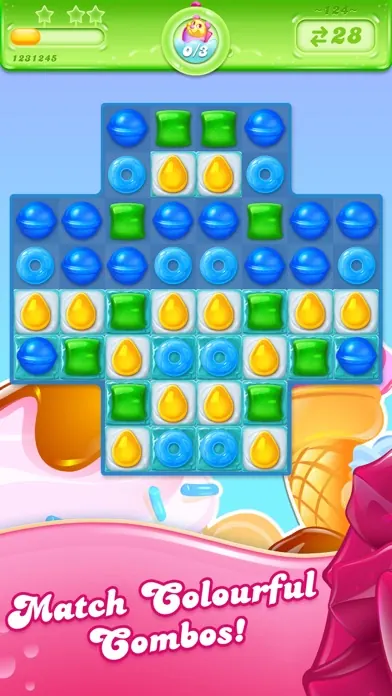
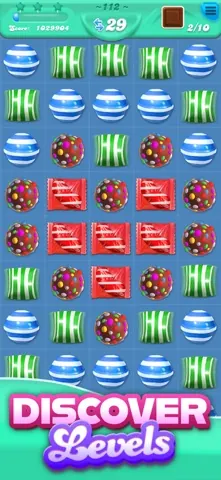
Screenshots from the official Australian store listings. All rights remain with the publisher.
Characters: the puzzle before the puzzle
The friends variant attaches an ability to a chosen character, triggered by a particular kind of match. Picking the wrong character makes a stage substantially harder, so a decision you make before the board even loads carries real weight. It also puts the most on screen at once — a larger grid, an animated character, ability meters — which is why it is the busiest of the four to look at.
Which to install
- Playing in gaps of two minutes: the original. Stable board, quick stages, nothing to sit through.
- Playing with full attention: the soda board. The changing geometry is the whole appeal.
- Enjoying the thinking part: jelly. Territory scoring rewards planning more than the others.
- Wanting variety per stage: friends, provided the extra motion on screen does not bother you.
What they share
All four are free to download, all four are rated 12+ on the Australian App Store, and all four sell optional extras — lives, boosters and bundles. The economy is essentially identical across the family, so choosing between them is a question of which board you want to read, not which one treats your wallet better.